Stanford ESW
  • Home
  • About
  • Projects
    • 2024-25
    • 2023-24
    • 2022-23
    • 2021-22
    • 2020-21
    • 2019-20
    • 2018-19
  • Blogs
    • FRESH
    • Button Barons
    • Renew Crew
    • Ghost Net Busters
    • Archive Blogs >
      • Biochar Project 2024
      • Sustainable Fashion Project 2024
      • Pie Ranch Project 2024
      • Glass Crusher Project 2024
      • TES Project 2023
      • Zorzal Cacao 2023
      • Biochar Project 2023
      • Glass Crusher Project 2023
      • Zorzal Cacao 2022
      • Boomitra Project 2022
      • Biochar Project 2022
      • Zorzal Cacao 2021
      • IBEKA
      • TCHO/CRIG 2021
      • Kokoa Kamili
      • Structures Team Blog
      • Robotics Team Blog
      • TCHO Team Blog
      • Zorzal Team Blog
      • AR/VR Design Blog
  • 2024-25
  • Contact us

TES 2023

From Blueprint to Life:   The Protyping Process

4/13/2023

0 Comments

 
Picture

The Thermal Energy Storage (TES) team spent the first three weeks of the quarter working on the following tasks — identifying which technical requirements the first iteration of the prototype would target and what materials such a prototype would require. 

Specifically, the TES team’s first iteration of the prototype will be a smaller scale model that employs a hot plate and stainless steel pre-made container model that tests the exchange of heat into the internal shell specifically. We chose to focus on these technical requirements because it is the most important aspect of the stove, to transfer heat to a storable shell; of course, the final prototype would scale the charging portion, cooking surface, and external shell to a larger scale: We plan on performing the following tests: 

INITIAL PROTOTYPE
Heat output: after connecting the hot plate with the stainless steel container, will use a infrared thermometer to measure both the internal shell and external shell temperature
Heat retention and insulation: will test the storage component of the device and measure the length of time that heat is retained at a certain value, thus 
LARGER SCALE PROTOTYPE
Discharge testing:  Use TES material to heat 2 kg of water, measure temperature difference. After reaching equilibrium, place an additional 1 kg of water to determine how much residual energy remains in TES material
Charging testing: Incorporate OTP circuit system and test the length of time device works when fully charged + OTP circuit integration (failsafe for when temperature is too high)

Initially, our team struggled with scaling our high-level prototype to a smaller, more manageable, and targeted prototype. We recognized that we couldn’t perform isolated tests on our prototype because the three main components of our product — namely, charging, storage, and discharging — are inseparable from one another. After multiple group meetings and conversations with members of the teaching team, we decided that our prototype will focus on heating and insulation, as explained above. 

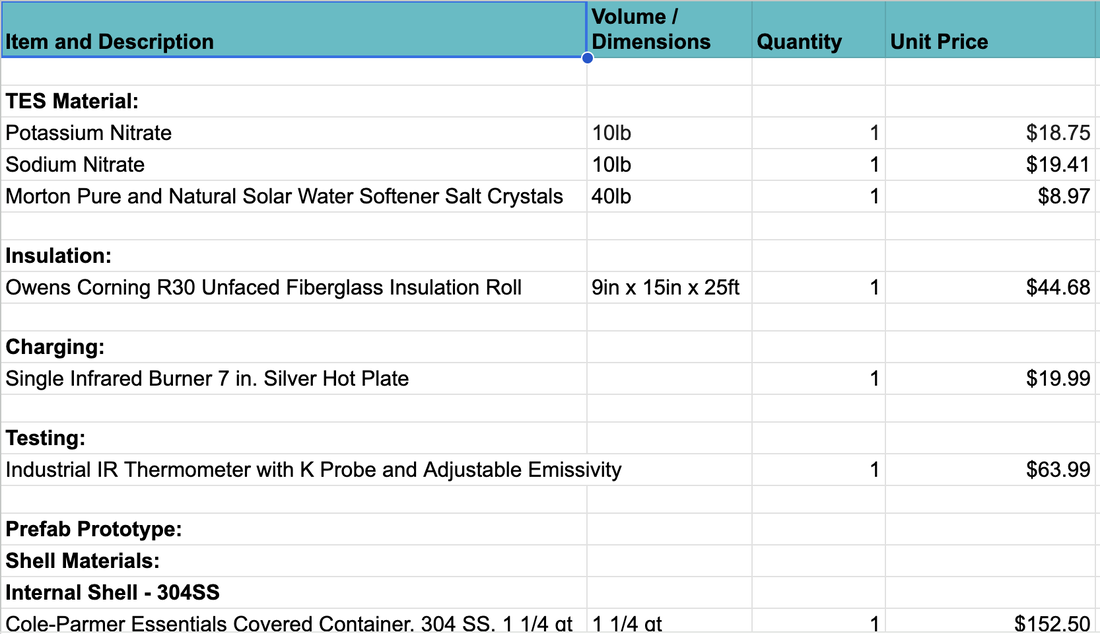
Finalizing the design and testing concepts for the first iteration of our prototype was a difficult but important step, as it influenced our final budget which includes the materials we seek and where we ordered the materials from. Here is our breakdown of the budget: 


​


​


​

​
​Note that we put in an order for sheet metal; our goal is to weld this sheet metal into an internal shell. As of now, no member of the TES team has welding experience, so we plan to outsource welders — perhaps a friend who’s further down in the Mechanical Engineering track. 


Our plan for the next two weeks leading up to Week 5 is to build our first prototype. The team will resume its out-of-class two-hour-meetings (held on Wednesdays from 8-10pm) to put all the materials together. As of now, we expect to have all the materials by April 26 — the hot plate comes in last. Once the materials are delivered, we will build the prototype and record a video to document the aforementioned tests we plan to perform and record our observations and results. Then, we will begin ideating for our second iteration of the prototype. 

From a non-technical standpoint, last quarter we identified that a major challenge was establishing a direct point of contact with our Indigenous users. We recognize that our positionally as a group of non-Ecuadorian Stanford students inherently requires us to establish this mode of direct communication with our direct user; unfortunately, communication with our community partner, Beyond Chacay Foundation, has been rocky. In the next two weeks, we plan to engage in at least one group call and ask to talk with at least one Indigenous woman who cooks for her family. 


0 Comments


Leave a Reply.

    Author

    Write something about yourself. No need to be fancy, just an overview.

    Archives

    May 2023
    April 2023

    Categories

    All

    RSS Feed

Powered by Create your own unique website with customizable templates.
  • Home
  • About
  • Projects
    • 2024-25
    • 2023-24
    • 2022-23
    • 2021-22
    • 2020-21
    • 2019-20
    • 2018-19
  • Blogs
    • FRESH
    • Button Barons
    • Renew Crew
    • Ghost Net Busters
    • Archive Blogs >
      • Biochar Project 2024
      • Sustainable Fashion Project 2024
      • Pie Ranch Project 2024
      • Glass Crusher Project 2024
      • TES Project 2023
      • Zorzal Cacao 2023
      • Biochar Project 2023
      • Glass Crusher Project 2023
      • Zorzal Cacao 2022
      • Boomitra Project 2022
      • Biochar Project 2022
      • Zorzal Cacao 2021
      • IBEKA
      • TCHO/CRIG 2021
      • Kokoa Kamili
      • Structures Team Blog
      • Robotics Team Blog
      • TCHO Team Blog
      • Zorzal Team Blog
      • AR/VR Design Blog
  • 2024-25
  • Contact us