
|
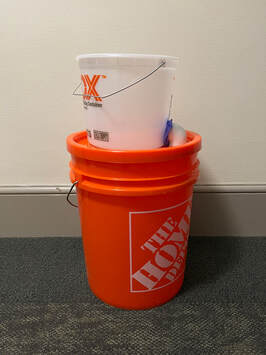
Welcome to our first blog post of 2023! The new Biochar team has been hard at work developing and revamping previous prototypes from previous teams. In this blog post, we’ll update you on the progress we’ve made in the past few weeks and highlight the key insights we’ve learned from the prototyping process thus far. Filter: Last quarter, the Biochar team pivoted away from the multi-bucket filtration system and started focusing on sizing down the filtration system to 2 buckets. The new model features a smaller bucket that sits atop a larger plastic bucket. After building the new prototype last quarter, the objective this quarter is mainly testing and perfecting this prototype.
In the first few weeks of this quarter, we carried out some preliminary mechanical tests for the filter, including stability, filtration speed and leak-proof features. We encountered some challenges, such as biochar tainting the water black because we did not add a filtration cloth at the water outlet, and slow filtration due to mistakenly using water-absorbing polymeric sand in the filter. However, we learned from these setbacks and made necessary adjustments to mitigate the issues. For the remainder of the quarter, we plan to carry out extensive water quality tests, with a focus on coliform and E.coli. We reached out to Professor Royal Kopperud, who generously agreed to provide us with lab space and IDEXX E.coli/coliform testing equipment. With his support, we hope to optimize the functions of our filter in removing microbes and satisfying the demands of our target communities. We're excited to continue testing and improving our prototype for the rest of spring, as each step brings us closer to achieving our goal of providing safe and clean drinking water. Kiln: This quarter, on the kiln side of the project, we are focused on building a larger kiln prototype. Based on the feedback we’ve received from our community partner, WESM, we decided on a size of around 5 gallons. The goal of building the larger prototype is to get a more accurate sense of the yield, burn time, and general thermodynamic behavior of a larger size kiln, since it differs significantly from that of a small kiln like the ones previously prototyped. Furthermore, building a larger kiln will hopefully allow us to actually use our biochar in the water filter (as opposed to store-bought biochar). The first step of this process was sourcing materials, which actually ended up being harder than expected. For the main body of the kiln, we started by ordering a 6 gallon mini trash can. However, when it arrived, we learned that it was made of galvanized steel, which is steel coated in zinc. We learned from our research that galvanized steel releases zinc fumes when heated, which are extremely toxic to breathe. As a result, we decided to find a different metal bucket to use. After checking lots of websites, calling companies, and reading reviews, we finally found a metal bucket that wasn’t made of galvanized steel, and also didn’t have an epoxy coating (common of many larger metal containers).
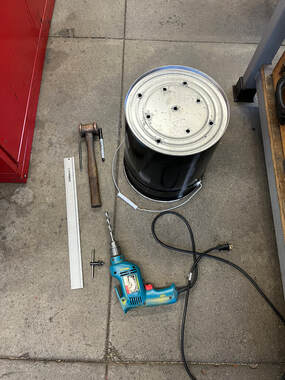
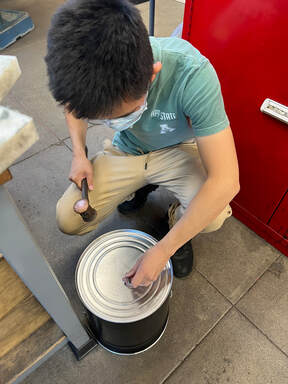
Next, we started the construction process, which we are still in the middle of. Following the guidance of an online tutorial and several different Youtube videos, we started by adding air-flow holes to the bottom of the main container. In the PRL, we used a ⅜ bit to drill a 3x3 grid of holes in the bottom. Our next major task is to work on the top chimney part of the kiln. This involves cutting a large hole in the lid of the main can, so that the chimney can sit on top. To make the chimney, we are planning on stacking several soup cans on top of each other (with their tops and bottoms removed).
We look forward to finishing the construction process and being able to start testing! Thanks for reading this post!
0 Comments
|
AuthorWrite something about yourself. No need to be fancy, just an overview. ArchivesCategories |
 RSS Feed
